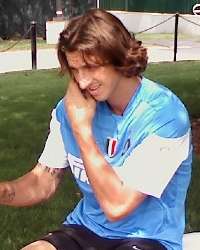
Last July, rumors swirled about the impending transfer of international soccer star Zlatan Ibrahimovic from Italy’s Internazionale to Spain’s FC Barcelona. What it would take for the Spanish side to prize the mercurial Swede from the Italian giants? According to some rumblings emanating from Milan, $60 million and Barcelona’s cantankerous (yet commensurately gifted) fireball, Samuel Eto’o.
I followed the deal closely, refreshing my catalog of relevant soccer websites and blogs with increasing frequency as I sensed the usual inertia of transfer negotiations giving way to the rapid climax of the matter. But only so much can be gleaned from articles, blog posts, or tweets, I knew. The Ibrahimovic transfer saga trudged on, an ocean away from my plain wooden desk at Harvard College’s Thayer Hall – a rising high school senior, I was taking two summer classes in Cambridge.
The morning of July 24, I woke up and checked the blogosphere once more for the status of the deal. Nothing. But, in my efforts, I stumbled upon a much more interesting detail: Inter planned to train for their upcoming friendly in New England – at Harvard today.
Internazionale. Walking distance. From me.
Enter ultra-fan mode. White t-shirt, crisp for autographs? Check. Sharpie? After a furious scramble through CVS, check. Still a bit unfamiliar with the campus, I mapped out the distance from my dorm to the field and calculated how early I should depart.
Then I calmed down a little. Okay, so I’d go see the team’s public training session, but that’s it. I would watch for a little bit, inevitably become swept up by Inter’s presence and prowess, and then go to my fiction-writing class.
Then I saw Jose Mourinho on Harvard Street.
Screw the fiction-writing class.
The Inter coach ambled confidently beside two heavyset Italian men in my direction, his managerial hauteur evident. No one noticed him except me.
I enviously eyed Harvard’s soccer team players, who shuttled the Inter players to the enclosed practice field on go-carts with annoying insouciance, as if this were something humdrum, no big deal.
The practice session, even from behind a fence, was a marvelous showcase of talent, replete with sizzling strikes, quick interplay, and mesmerizing – if not "albi-celestial," as Gol TV’s Ray Hudson says – exchanges between Inter’s impressive cadre of Argentinians.
I left as the session began to wind down, smiling to myself, pleased with what I saw despite my white Hanes t-shirt’s conspicuous whiteness.
Then I saw an angelic figure perched on a small faded blue cooler, extending his lanky, extremely long, pale legs and speaking intently in a foreign tongue on his Blackberry while scratching the brown locks on his head. Zlatan Ibrahimovic: the superstar I’d been reading about, apparently pining for the Catalan sun, was now hunched over ten yards from me in front of Harvard’s brick field house, taking in the Cambridge variety.
How was this scenario even possible? Try globalization. In the last 10 years, European soccer clubs have made America the latest theater of their proxy wars for popularity and, in essence, profitability. The European soccer cognoscenti perceive the land of the free as a future giant, one whose youth present an untapped oil field of talent that, upon investment, may yield a few good players into their academies on the cheap. Hence the visit Stateside. The Nerazzurri also came to brand, sell some kits, and perhaps even subtly proselytize American kids into supporting a decent European club they saw in person.
But it didn’t matter if you didn’t have tickets to the friendly against AC Milan or the serendipitous pleasure to stumble into Ibrahimovic. Americans, thanks to Fox Soccer Channel, Gol TV, and ESPN, have an easy time – perhaps even easier than any of their soccer-crazed counterparts across the pond – watching the most high profile matches in England, Spain, and Italy every week.
The fact that I can say, without equivocation, that I know as much about the footballers which grace Premier League pitches each week as an Englishman does – without leaving my suburban Maryland home – is truly amazing. That I stand before a Swedish soccer player – one in the process of transferring from an Italian team to a Spanish rival – in America on the campus of a internationally-renowned university, all after watching his teammates of Argentinian, Brazilian, Nigerian, Romanian, and, of course, Italian descent, is beyond remarkable.
But on July 24, it’s safe to say that I didn’t weigh the media’s hostility or utility to the soccer fan. I didn’t marvel at what information I gleaned thanks to the Internet. And I definitely didn’t remember anything that happened in my fiction class. I just remember this.
My heart flits, springing out my chest and into consciousness. That’s him. I press my palms together vertically, like a supplicant before a god: a picture, please? Saint Zlatan sits languorously on the dull blue cooler, true to the gangly figure I’ve seen on TV. His eyes finally catch mine and I now know my fate lies in his whimsy. Yes or no. Heaven or purgatory.
He takes his cell phone down from his ear and my insides are aflutter. His long fingers motion me toward him, at least I think so, I cautiously approach, not wanting to scare him with my crazed excitement. He avails himself of his preternaturally long limbs and snaps a picture of both of us with my camera. I think I made it to heaven—only later to see a cavalcade of sweaty men in blue “Pirelli” uniforms processing towards me. Now, I’m in heaven.
An hour later, I’m still smiling. I beam all the way back to my dorm room, my white t-shirt now hallowed, dotted with autographs from Inter’s most exalted stars, my camera full of pictures, full of joy. I beam all the way back to my dorm room, my smile irrepressible, my experience unbelievable, my mind still making sense of the day when I read about a European soccer star in the morning and saw him sitting on a cooler in Cambridge just a few hours later.


No comments:
Post a Comment